Showing posts with label Evening Dress. Show all posts

Wednesday, May 1, 2013

Titanic Era Fashion


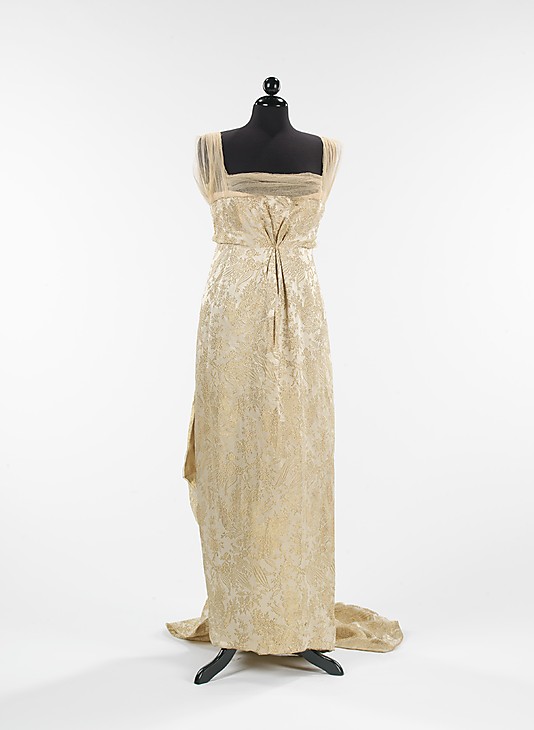
Callot Soeurs Silk Evening Gown
1910-1910
donated by Agnes Miles Carpenter to the Metropolitan Museum of Art.


Callot Soeurs Evening Gown
made of silk, cotton, metallic thread and metal beads
1911


Monday, April 29, 2013

Titanic Era Gowns


This evening gown, made by Callot Soeurs in 1914, was owned by Ethel Willard Sperry Crocker.  Ethel was married to William Henry Crocker, a business magnate who was the founder and president of Crocker National Bank.  She was the leading patron of French Impressionist art at the time.  William and Ethel donated their Nob Hill property to the diocese after their home was destroyed in the San Francisco Earthquake of 1906. Grace Cathedral was built on that spot.


(the inscription reads, "At this location, "1150" California Street, now the site of the Choir, stood William H. Crocker's Queen Anne style mansion (1888). The Deuxieme Empire-Italian Villa style mansion (1877) of his father, Charles Crocker, was at the N.W. corner of California & Taylor. Both buildings were destroyed in the earthquake and fire of 1906.")

William and Ethel went on to have a new house built by Lewis Parsons Hobart in 1910 where I'm sure she continued to have many opportunities to wear lavish gowns.

Titanic Era Gowns

I originally began researching vintage gowns in response to some reading I was doing on the Titanic.  Reading books and watching documentaries spurred my curiosity about the lives of those who made the fateful voyage.  Lady Duff-Gordon was a passenger and when I learned that she was known as the dress designer Lucile, I couldn't resist looking up some of her designs.  One thing led to another and I began wondering what the passengers might have worn on board the unsinkable ship.  Which of course led me here.  

I am excited to see that so many beautiful costumes still exist today.  While it's nice to see a designer's sketches, there's just something about seeing the actual gown.  It imagine t's easy for me to imagine the excitement of wearing a beautiful gown like this to a ball.  Who was there?  Who was popular?  Was her dance card filled?  Who was her favorite?  What food and drink was served?  What did the band or orchestra play?  Did she go home that night with stars in her eyes or was it just another event in a long line of obligations?  I want to know.


This gown was made by the Paris fashion house of Callot Souers sometime between 1910 and 1914.  According to the Metropolitan Museum of Art

"In the Directoire revival, the waistline was raised in the manner of a century earlier, but with corsetting that had the vestiges of the monobosom. Perhaps even more importantly, the silhouette reflects Europe's examination of Eastern dress, the softness, raised waist, and lower bust stance suggesting "ukiyo-e" prints and other Japanese style.

Attuned to the Orientalism of the decade, Callot Soeurs reined the silhouette into a cylindrical wrap, effortless in lingerie-weight fabric. Yet, for its innovations, the work of Callot Soeurs does not stint the couture's roster of technical skills. Here, sequins vary: some are punched into a filigree pinwheel, others are hammered flat; in some instances metal is overlaid onto faceted crystal. But even this ornamentation is not entirely for the pleasure of diversity, but for the calculated and magical effects of such varied surfaces seen in evening and candle lights."


Can you imagine it? 

Sunday, April 28, 2013

Evening Dress ca.1900 by Maison Laferrière


Evening Dress
ca. 1900
Maison Laferrière

This elegant evening dress was designed by the famous Paris fashion house Maison Laferrière, located at 28 rue Taitbout in Paris. Maison Laferrière was frequented by aristocrats and others of great wealth, who admired its exquisite designs and fine workmanship. Madame Laferrière's creations were among those shown by the Collectivité de la Couture at the Universal Exhibition of 1900 held in Paris.
This dress was worn by Princess Alexandra of Denmark (the future Queen Alexandra), who was considered to dress with exemplary taste.

The tight-fitting bodice is mounted on a boned silk foundation. It fastens at the centre back with original hooks and eyes (with positions reversed alternately to take the tension). A draped panel conceals the centre back and fastens at the right-hand side with hooks and eyes. 

 The gored skirt has seven flares panels, the two longer at the back are gathered into the waistband and form the train. Its hem is padded to maintain the flared line and the train has a frilled petticoat of cotton gauzes and lace.

Callot Soeurs Evening Dress c. 1909


Evening dress, c 1909. The sisters Callot - Marie Gerber, Marthe Bertrand, Régina Tennyson-Chantrell, and Joséphine Crimont - often used delicate materials in their very feminine creations. They were especially renowned for their exquisite lacework, such as the black, imbricated leaf pattern overlaid on pale taffeta seen here. This dress, finely embellished with black and silver sequins and rhinestones, represents the magnificence of fashions in La Belle Époque.